


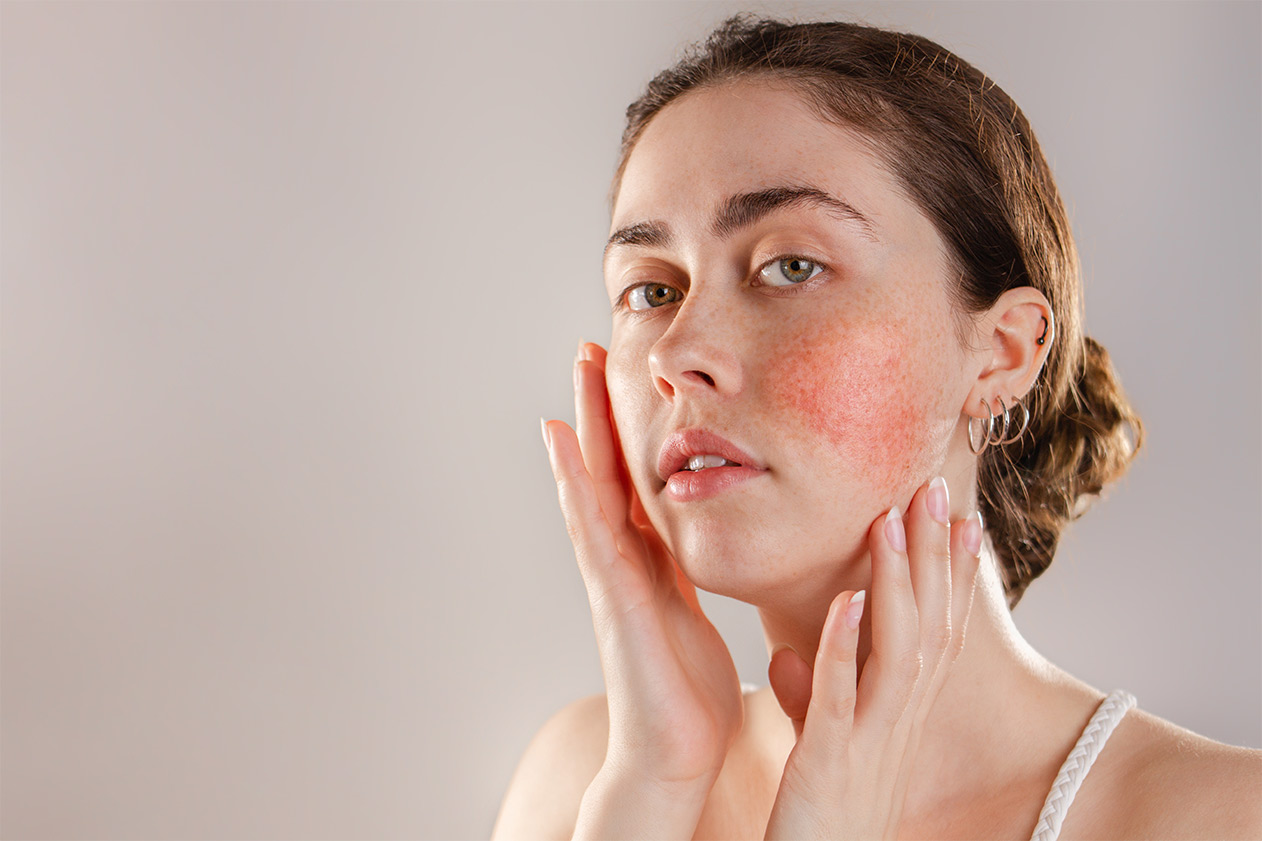
It represents a chronic, recurrent inflammatory condition of the central parts of the face characterized by redness, telangiectasias, papules, and pustules. It usually occurs in middle-aged individuals, although it can also affect younger people, and it’s more common in women.
What Causes Rosacea?
The exact cause of the disease is unclear, but undoubtedly, multiple factors play a role in the development of rosacea, such as infectious, dietary, immunological, climatic, and genetic factors.
How Does the Disease Manifest?
The changes manifest on the central part of the face (forehead, nose, chin), with the most common manifestation on the cheeks. Sometimes, the skin of the eyelids, décolleté, and earlobes may also be affected. The disease begins with transient intermittent episodes of redness; over time, erythema becomes persistent, takes on a livid shade, and numerous telangiectasias develop. Red-brown papules and papulopustules may also appear simultaneously or shortly afterward.
Therapeutic Approach to Rosacea
Treating rosacea requires a multidisciplinary approach involving local and systemic drug therapy, chemical peels, and laser treatments. The Candela Nordlys platform includes the treatment of rosacea as an indication. The basis of laser application with the medical Candela Nordlys multifunctional device in rosacea is the elimination of redness and reduction of capillaries using various applicators. Laser therapy is based on basic and advanced light technology, an advanced form of intense pulsed light (IPL), and a long-pulse NdYag laser at a wavelength of 1064 nm.
Namely, by emitting light of a certain wavelength, it acts on hemoglobin and oxyhemoglobin found within blood vessels. The light absorbed by blood is transformed into heat, which is then transferred to the vessel wall, causing coagulation and gradual reduction of the blood vessel and redness.
The treatment itself is safe, non-ablative, lasts for about 10 minutes, and a series of 4-6 treatments at intervals of 3-4 weeks is recommended.
After the treatment, the treated area remains slightly more pink than the surrounding skin, with a subjective feeling of warmth that can last from a few hours to several days.
Post-treatment care: the mandatory application of creams with a protective factor along with therapy prescribed by a dermatovenereologist.